The Navier-Stokes AI video I didn't make
An AI company solved a millennium prize problem under possibly shady circumstances, and then the entire math community began a frenzy of responses reimagining what mathematics will look like forever. So, where is my video on it?
In a previous post, I stated I am not working on YouTube this semester. I am focusing on health and academics… but four weeks ago I made an exception. I emailed my collaborators that I would be spending the next 3-4 weeks working on a video talking about the Navier-Stokes saga and, more importantly, the responses the mathematical community has had to it. As it has now been four weeks since that point, the video should be out about now. Where is it?
As luck would have it I had a crash and spent three of those four weeks very sick. I’m mostly emerged from my worsened health state… though still not entirely. At this point I could limp along and complete this video that has parts that are painfully out of date already, or I could get back to my priorities. I am choosing the latter.
However, I did read a lot, think a lot, and write a lot about this subject. So, I’m using this blog post to share a highly condensed, arbitrarily cut, rushed out version of some thoughts you would have found in the video.
Navier-Stokes, the Problem, Solution, and the Saga
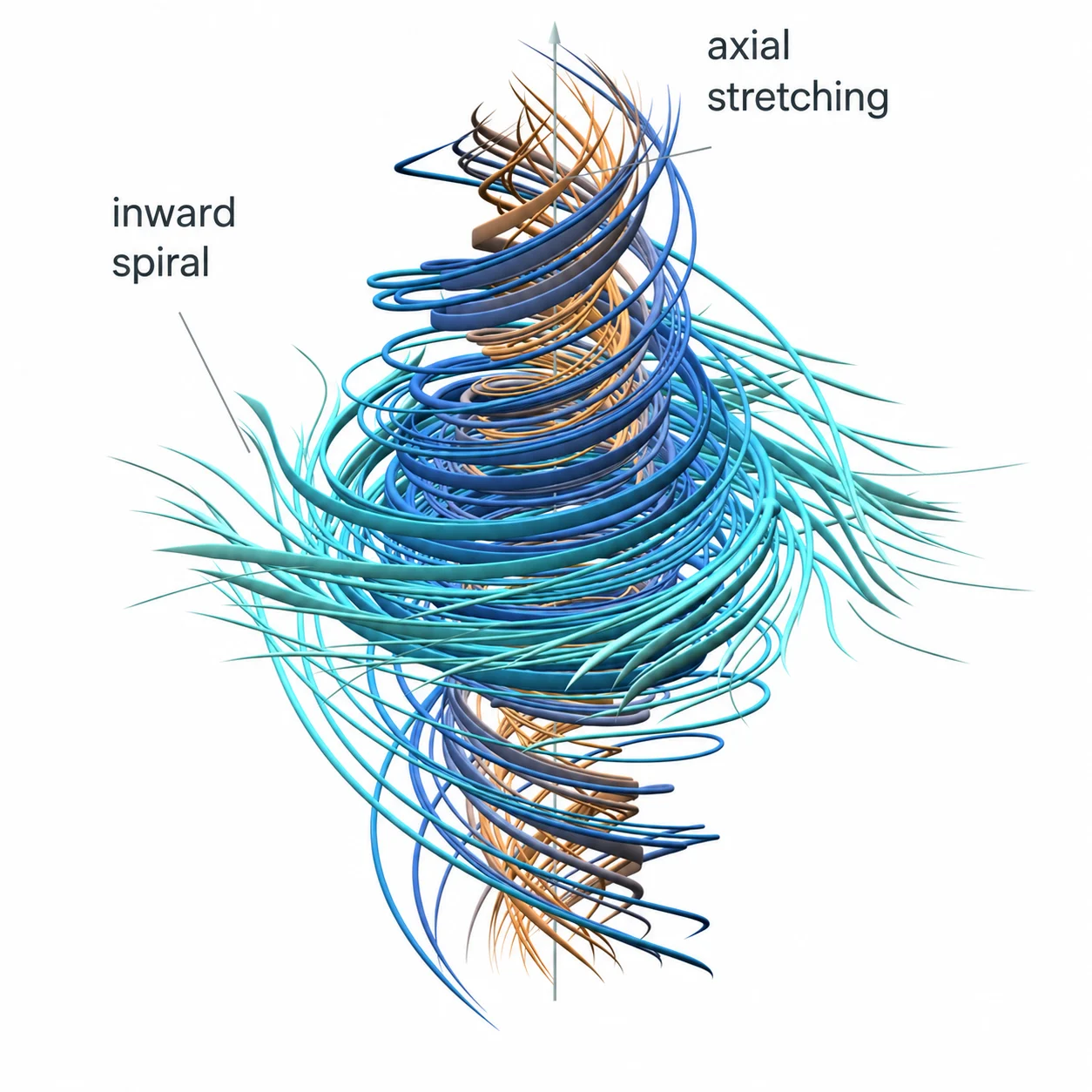
To begin the video, I was just going to talk about Navier-Stokes the mathematical problem and its implications independent of the AI use or drama. Basically, this part would remain unchanged if a single human researcher had come out with a solution.
The Navier-Stokes equations, written below, encode the dynamics of an incompressible fluid (most notably water) under a force $f(x,t)$ over time. It models the fluid as a continuum, i.e. as one continuous matter, via data $u(x,t), p(x,t)$ that encode its velocity and pressure respectively.
\[\rho(\partial_tu + u\cdot \nabla u) = \eta \Delta u - \nabla p + f\] \[\nabla\cdot u = 0\]While the equations look complicated, the first equation is more or less $F = ma$, and the second equation translates to “the fluid is incompressible.” The left-hand side of the first simplifies to \(\rho \frac{\mathrm{d}}{\mathrm{d}t} u(x(t),t)\) which is the acceleration at a point multiplied by the density of the fluid $\rho$. That is, $ma$. The right-hand side is $\eta \Delta u$ which is the force of internal friction of the fluid on itself: if surrounding fluid is moving faster than it will drag fluid along in that direction. The $- \nabla p$ is the force of pressure: This is basically the direct force of the fluid pushing on itself. And the $f$ term is any external force not coming from the fluid. You can imagine gravity being a constant $f = -g$ or if someone is splashing around you would have a more complicated $f$.
The million dollar question asks whether these equations are well-behaved. That is, if you start with some initial velocity/pressure, smooth forcing (with some other regularity conditions), can you guarantee a smooth solution for all time? That is, you don’t have a “blow up” like a point in space/time that has infinite velocity. This would be very unphysical. Technically a blowup means a blowup in any higher derivative of $u$ though it was proved in the 80s that any blow up would involve a blow up in vorticity ($\nabla\times u$). There was always going to be infinite vorticity if any blow up was found.
To solve Navier-Stokes, Charles Fefferman’s statement[1] offers four options: a) b), c), and d). The first two involve showing regularity of solutions in the unforced case when $f=0$ where the space is $\BR^3$ ($3$ dimensional space) or $T^3$ ($3$ dimensional space with periodic spatial conditions). That is, show that the equations are well-behaved. Options c) and d) were to construct a blow up, possibly using an external force $f$, on spaces $\BR^3$, $T^3$ respectively. The OpenAI solution constructed a blow up and thus satisfied c) and d).
So, can we blow up fluids now or are the Navier-Stokes equations a bad model for them?
During your next bath, if you splash the water just right could you create a vortex reaching infinite velocity that would be so powerful it destroys not only the rubber ducks but the entire world? No, fortunately not. One must remember that the Navier-Stokes equations, like every other mathematical description you can find in physics, is a model. It is a description of reality but it is not a full one. Oftentimes we can confuse the descriptions with reality because these descriptions are extraordinarily good. This result really tells us that for this model of fluids under rather specific forcing you can form a blow up.
So, this means the latter is true right? Navier-Stokes is a cooked model and its time to move on to bigger and better things. This conclusion is wrong too. Although we have now found a very unphysical solution to Navier-Stokes, that does not mean it is a useless model. In fact, I wouldn’t be surprised if this result doesn’t change how those modeling fluids with Navier-Stokes work at all.
This reminds me of when I took complex analysis and learned about the Joukowski air-foil. It was a model of air-flow which was used to design airplane wings. It modeled air as
- 2-dimensional
- Incompressible
- Torsion-free
- Inviscid
All four of these things are wrong about air. Yet, it was good enough to get a plane to fly. In that same class, the professor told an anecdote about Abraham Robinson—a mathematician famous primarily for creating nonstandard analysis. However, Robinson used to work in applied mathematics and used these techniques. My professor told us that as a grad student he knew Robinson and that Robinson would brag that his work on airfoil design “lead to the allies winning the air war” during world war 2. Although this model is expressly wrong in many assumptions, possibly apocryphally it was good enough to win world war 2.
In reality, this result teaches us most about Hilbert’s sixth problem. The millenium prize problems were inspired by David Hilbert’s 23 problems published around the turn of the twentieth century. Famously known as the last man to know all of mathematics, he was tasked with coming up with a set of problems to guide mathematics for the next one hundred years. These problems included things like: Is there an infinity of size between the naturals and the reals? Given two polyhedra of equal volume, can you cut one up and reassemble it into the other? The Riemann hypothesis (which survives on the millenium prize list), and notably for this post: the sixth problem.
Among the things that the sixth asked for, it asked for a proof of compatibility between the models of fluids as a bunch of particles colliding with each other and the smooth models of fluids given by Boltzmann and Navier-Stokes. That is, we have these different physical models of how fluids should behave, do their predictions contradict each other? Or, in the positive side, can we show that the predictions are consistent with each other.
Quite recently, there was a big breakthrough in this area which was a large contributor to Yu Deng’s recent fields medal. In March 2025, Yu Deng, Zaher Hani, and Xiao Ma proved that in the limiting case, the Newtonian collisions of particles model behavior converges to the continuous models of fluids.[2] This is a positive result for Hilbert’s sixth demonstrating coherence of different models. The Navier-Stokes result is in some sense a negative result.
In totality, Hilbert’s sixth problem asks for a lot. It asks to find mathematical axioms describing all physical phenomena and to produce proofs of their mutual consistency. Famous intractable problems such as “quantum gravity” would qualify as just a part of this program. However, when Hilbert wrote this program neither quantum mechanics nor relativity had been discovered.
The sixth is comprised of the most foundational questions of mathematical physics: What are the rules that accurately describe the physical world? Are those rules consistent with each other? With Navier-Stokes blow up, we have learned more about both.
The saga and dispute
Let’s start with a rather rushed recounting of the events. In September 2025, Levent Alpoge, a number theorist who works at Anthropic, reaches out to to Tristan Buckmaster, a professor at NYU working in fluids/PDEs, to work on constructing blow ups with lots of LLM assistance. Crucially, he does this not as a part of Anthropic. For the next year or so they work on this and starting in August they say get some good results. They’ve constructed blowups in fluid equations related to Navier-Stokes: IPM, boussinesq, and forced Euler equations.
Early September, OpenAI hears a rumor that a “rival AI company” (who could it be?) has solved one or two millenium prize problems. They immediately deploy a team to work on solving millenium prize problems with many agent swarms working with their internal model. In 50 hours they find an unforced euler blow up, and in 88 hours they have a 10,000 agent swarm that constructs a blow up for Navier-Stokes equations. Estimates I’ve seen for this compute cost have ranged from $5m to $30m. The most common figure I’ve seen is $15m.
Buckmaster hears about this and contacts OpenAI to meet and discuss what has been going on. On a Sunday afternoon, he has a very tense an surreal sounding meeting with a representative of OpenAI, Sebastien Bubeck. In this meeting, deals are proposed for him to write up OpenAI’s Navier-Stokes solution without his collaborator Alpoge (because he works at Anthropic), its proposed that OpenAI would say that he and Alpoge should get the millenium prize problem as “the closest humans to the problem.” Buckmaster rejects the offers and says that if OpenAI proceeds as they plan to he will go public with details of this meeting. In response, Bubeck said either “Why would you ruin your career?” or “Why would you risk your career?” depending on which account you go by. Buckmaster also suspects that OpenAI illicitly accessed his and Alpoge’s prompts and used this to get a leg up. That is, he believes OpenAI stole their in-progress results to scoop the grand prize of Navier-Stokes blow up.
There is a lot going on here and quite a lot to be uncomfortable with. Buckmaster’s personal statement reads like having a run in with the mob. Its full of backroom dealmaking, refusing to work with someone else because they’re part of a rival gang, and vague threats. Though some of this account is disputed. Here is what I have concluded through looking at the sources.
I have seen no convincing evidence that OpenAI accessed Alpoge/Buckmaster’s prompts but I do think it is worth further investigation. In Buckmaster’s statement, he states he suspected they had acted improperly after they told him they solved Navier-Stokes by finding a forced blowup via c)/d) in Fefferman’s statement. To him this was a big red flag as that is “not the direction one arrives at after a few days by giving a model the problem statement.” Perhaps it might reflect my ignorance of fluid dynamics, but that would be the direction I arrive at in a few minutes. It is essentially the “find a counterexample” direction and it is clearly laid out in the problem statement. In later talks Buckmaster would provide additional evidence by stating that OpenAI’s unforced Euler blow up was very similar to what he had been working on in private. This is better evidence, though still amounts to your agents have come up with the same idea my agents came up with and we have seen different, nearly identical, AI aided proofs come out with e.g. the Feige conjecture.
All that said, OpenAI could have stolen from Alpoge/Buckmaster’s prompts. As we’ve seen with the Huggingface incident, OpenAI’s swarm could also have independent of their masters hacked into other systems, stolen information, and then acted in ways to hide their tracks. Giving a 10,000 agent swarm a known to be very difficult problem, a section of that swarm might rightly conclude that their best bet is to try to illicitly gather all the information from competitors they can and pass it off as their own. I would call such speculation silly science fiction had incidents like this not happened at the same company just a month prior to this Navier-Stokes saga.
So, while I don’t see any evidence that makes me believe OpenAI’s Navier-Stokes blow up was created from accessing Buckmaster’s prompts, I still think they should do a full audit of the work their agents did. The future of research may look like mathematicians asking questions of bots and them churning about. If there is a suspicion that such chats can be accessed at any time that may freeze people’s work whenever progress starts. Similarly, if that is paired with a devaluing of producing novel theorems then we may have a worst of both worlds where nobody works on producing interesting theorems because you don’t gain much from their production and their is the fear that you may be scooped by other actors. It is important for the mathematical world to have confidence that their works in progress are not at constant risk of being stolen
I’m very very disturbed by the other details of the OpenAI interaction with Buckmaster/Alpoge. I don’t like that they were refusing to work with Alpoge due to his affiliation with Anthropic. I find it a mix of cute and disgusting that they were making deals to offer their endorsement of who should get the millenium prize problem. There is no shortage of arrogance in them thinking their opinion should have any bearing on who gets the millenium prize problem at all. And finally, it is absolutely, and in no uncertain terms, unacceptable for them to threaten or even say something that suggests a threat to anyone.
Sam Altman shared the following tweet:
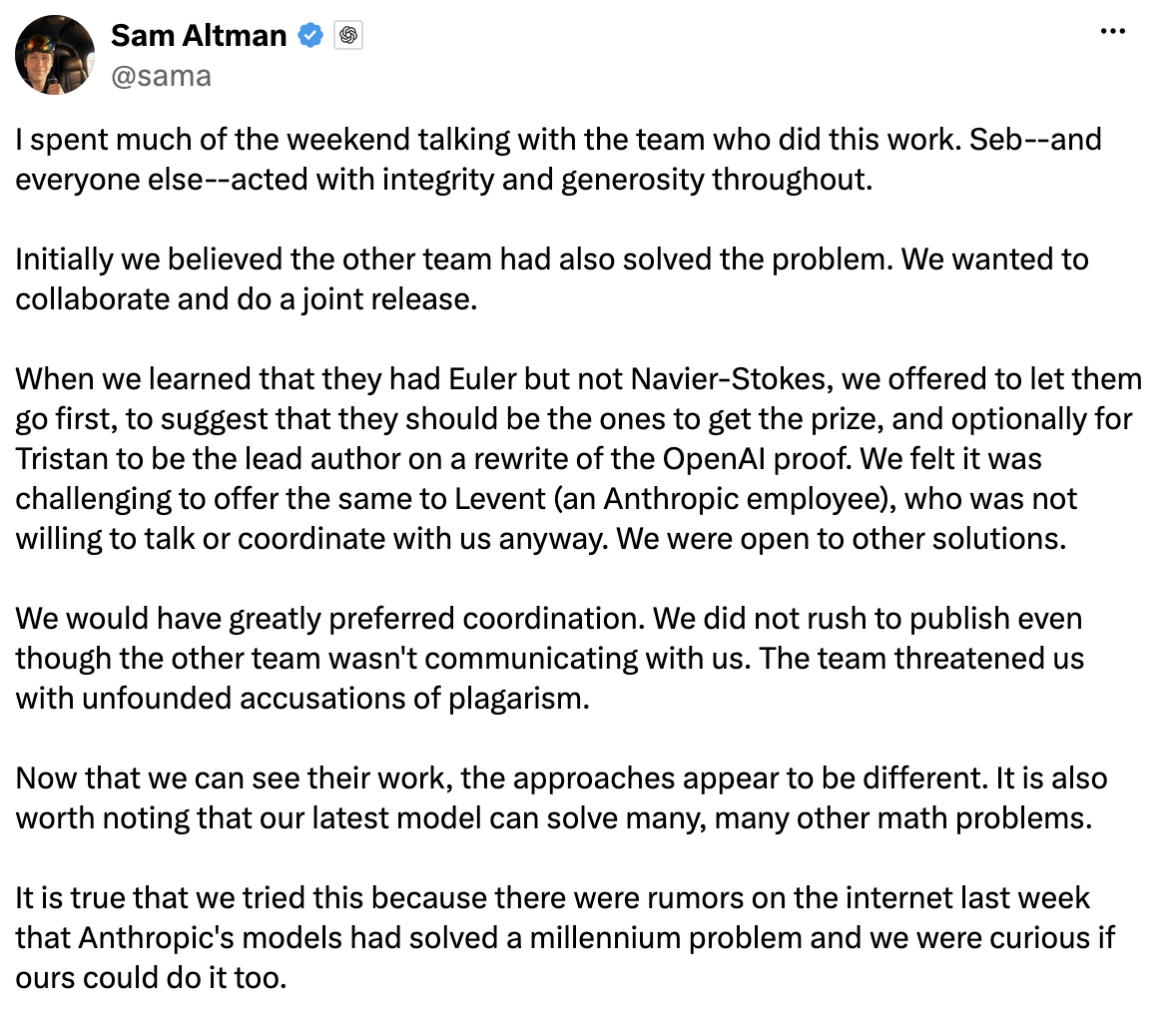
Reading this tweet, I get the distinct impression that the AI CEOs have little to no self awareness. He portrays themselves as patient curious stewards just wondering what the AI can do. Nothing says patient like hearing a rumor someone else has a result and immediately putting a team and millions of dollars of compute spend to capture the prized result, and then pulling Buckmaster into a tense a meeting about all this on a Sunday afternoon.
Similarly, I find the complaint that Buckmaster “threatened us” comical. You are at the helm of a trillion dollar AI company. Tristan Buckmaster is an NYU professor. How can he credibly threaten you guys at all? On the converse, you could credibly threaten Tristan Buckmaster. You could sue him to oblivion. You could blacklist him from all of your technology which is now essential for math research. You could make his life incredibly difficult in so many ways. This is why it is completely unacceptable for a representative of your company to say “Why would you ruin your career?”
OpenAI is the titan in the room and it isn’t the only titan in the room. Oftentimes, it feels like these titans are fighting to prove supremacy while the rest of us are running around at their feet trying to not get stepped on. Reading this tweet feels like listening to the titan complain about having to mind its feet.
It may feel like this is holding these titans to a very high standard of morality. Sebastien Bubeck said he did not mean to threaten, that he used the word “risk” not “ruin” and that he retracted the comment. People slip up. While all that is true, I don’t think this is the highest standard to hold them to but I think they should and must be held to a high standard. These AI companies wield enormous, earth-shattering, power and if they can’t meet high standards of respect and responsibility than they shouldn’t have that power in the first place.
What was the breakdown of human work vs. LLM work? How much of a contribution did the machines make anyway?
Either way you slice it, the machines did the vast majority of the mathematical discovery. If you take the line just including OpenAI, the machines did all of the discovery of new mathematics and the humans prompted the machines with various questions and sometimes facilitated sharing of information between different agents. That is, they would prompt a group of agents to create a summary of their best ideas to share with other agents.
If you consider the Alpoge/Buckmaster line, things aren’t much better. In this New York Times interview[3], and this recent talk, Buckmaster describes how the LLMs came up with the new ideas. The part he played was asking questions which reduced the search space, which is not nothing, and the most significant work for humans seems to be translating the AI output into something readable. That part still takes significant human input.
The AI did make very significant discoveries that lead to the Navier-Stokes solution. AI-aided mathematics or not, we often have a bad habit of just recognizing the last person to make contributions toward solving a problem. When a big problem is solved in mathematics, the work its built on often includes dozens, sometimes up to hundreds of mathematicians. Solving a problem is like finishing a long relay race and we often celebrate whoever (or now whatever) ran the last leg. Was this last leg the AI ran significant?
Yes, it was. It was not simply simulation, nor a brute-force search through known ideas, nor another one of the dismissive claims some are making. In Buckmaster’s words, he thought that without AI we would have solved Navier-Stokes in ten years or so. That is, it condensed the work of top mathematicians on a millenium prize problem from ten years to either one year or four days of AI-aided work (admittedly with enormous computational resource spend). This is significant.
How does this work compare in originality or significance with the work that predated it? This is hard for me to ascertain and should be left to the PDEs/fluid mechanics experts. In Buckmaster’s statement, he said he believed Diego Cordoba and Luis Martinez-Zoroa should get the millenium prize in Navier-Stokes. They did significant recent work in constructing blow ups for fluid equations which Alpoge/Buckmaster directly built off of and that the OpenAI work likely built off of too.
Truthfully, I have not seen an expert give an opinion on what degree the AI contribution is compared to, say, the human contributions of the last decade or two. I wonder if a human had come up with what the AI had come up with in this saga, would they get the millenium prize problem without it being shared? If that is the case, should that matter? Should the prize simply go to the humans who made the most significant contribution?
Either way, the millenium prize’s luster is significantly damaged. Prizes like the millenium prize, Fields medal, or Abel prize allow the mathematical community to anoint champions. We celebrate the greatness of these heroes and they are forever imbued with a status that makes them great ambassadors for the field. This authority allows those, especially outside of the mathematics community, to know who the community values and gives the community as a whole greater legitimacy. I worry that whomever the millenium prize goes to, if it goes to anyone at all, it will have lost that power.
The millenium prize problems have perhaps the simplest story for the public of any of the prizes. Here are seven really really hard math problems. They are so hard we are offering a million dollars for a solution to just one of them. Whoever can solve one of these is a truly great mathematician and has made a historical achievement. In the age where reasoning machines appear to be the best at mathematical problem solving, I wonder if winning a millenium prize in the future will hold much weight at all.
What does this mean for mathematics?

This section is the most cut down and compressed of all the sections. In the video it would have taken up the majority of the time and as I’m writing this, I could see the cut-down version taking a majority of this post too. Although this post is really quite long so I’ll avoid that fate if I can.
In the just under a month since the Navier-Stokes solution was announced, there has been about an essay per day posted on Terry Tao’s blog about the future of mathematics in the AI age. Prominent figures are mourning the death of a type of math research. In Daniel Litt’s talk, he said he believed there is no future for mathematical journals. In under a year, the most valuable currency for most mathematical careers, the proof of a hard theorem, is quickly becoming the least valuable. In its wake, the community is embracing standards centered around “human understanding” and proposing conference tracks focused on definitions/questions and career advancement based on one’s ability to create quality mathematical exposition.
There is a ton to break down here, so I’ll go point by point.
First of all, what can/can’t the LLMs in math research do right now? It is rather hard to say what they can’t do—how does one prove this? So really, this question is what have we seen them do and what do they seem to struggle at in math research? Let’s look at the mathematical research pipeline:
- Learn stuff
- Ask questions
- Answer questions
- Build theories
- Write textbooks about it
Of course, this is not a clean pipeline. Generally all of these things happen in tandem and in mixed orders. But, it does provide a framework to work from. The machines are now very good at step 3. and, in tandem, step 1. Although there is a fair argument to make that their step 1. isn’t the same as our step 1. (nor what we value). Unaided by humans, it seems to struggle a lot with step 5. It often doesn’t know what we find easy to understand or what we find difficult.
For step 2, this is hard to say. I’m not sure anyone is asking it to come up with important questions. What would an AI company gain by doing so? How do we know when a question is important? Questions certainly are important and I would have argued more important than they are given credit for even before all this AI stuff. A good question tells us where to look for interesting and significant phenomena. One could argue that Erdös’s questions were more important than his answers.
Step 4 is in a similar spot to step 2. Has anyone asked it to build a whole theory? Has anyone asked a giant swarm to search the mathematical literature, find a hidden pattern in lots of work, build out a set of definitions and new classes of objects/phenomena that unify these different areas? I’m not sure they have. Although, in light of its struggles with step 5 I would not be surprised if it struggled with step 4 as well. Theory building does require a good theory of mind. We want to make definitions, such as manifold, topological space, graph, that make things more understandable to us. It would be a fascinating development if the machines found a theory that compressed a lot of mathematics but wasn’t understandable to us. That is, if they came up with a set of definitions and theorems that were deeply unintuitive but manifestly very powerful. Either way, we haven’t seen a new human-theory, or machine-theory of this kind out of the LLMs thus far.
It may seem that 3/5 of the steps, debatably 4/5, are comfortably with the humans and thus we might not see things change too much. Well, for most mathematical careers prior to AI, step 3 was both the crux and most valued thing most mathematicians would produce. Most mathematicians don’t come up with large new theories—though most may contribute to them. Similarly, for building out a career, generally the proof of worth comes in one’s ability to produce in step 3. This is a huge inversion.
We don’t know that AI will wholesale replace step 3. It is possible that the best strategy for answering questions will involve a lot of collaboration between the AI and humans. Perhaps coming up with the kind of answers we humans want will require this. That said, I think the other important thing to look at is not only where the AI is now but the trajectory.
What will the AI models be able to do? This is quite hard to predict, but we can look at the trajectory so far—which I have mostly lifted from the beginning of the previously mentioned Daniel Litt talk.
- March 2023: GPT4 can get around 90% on word problems for elementary school students
- December 2024: Models can get 75% on high school math competition problems (mock AIME)
- July 2025: Gold medal on IMO problems
- January 2026: First Erdös problem solution
- May 2026: OpenAI’s internal model disproves the unit distance conjecture. First top-level mathematical result
- Summer 2026: Many problems, e.g. the Jacobian conjecture, solved via heavy AI assistance
- September 2026: Navier-Stokes problem blow up constructed.
For me, the unit distance conjecture disproof was the wake up call. It came suddenly—prior to that proof all of my experience with the LLMs doing mathematics was very disappointing. I would ask them basic questions in even elementary group theory and it would get them confidently wrong. Frankly, besides having them write code to my specification, getting something that would help with mathematical research out of them was difficult. This has completely changed in the last year.
When I saw the unit distance conjecture disproof, it showed that it could do high level mathematics and connect original ideas between subfields. That is, it was doing high quality mathematics. That didn’t mean it could do anything, but to me it seemed to show that it could take over all of mathematical problem solving. There are no clear barriers here and what stops one from continuing to scale and improve? The months following that result have seemed to confirm this prediction.
Even though it has resolved Navier-Stokes and seems to be outrunning human beings in problem solving, that doesn’t mean that this is the cap for machines. I have seen no indication that there is a cap on mathematical problem solving ability at the level of the best mathematicians—it would be very interesting were that the case. It could become much better than any human being by orders of magnitude. For me, this would look like it proving P is not equal to NP.
Being part of the theoretical computer science community, we are no where close to showing P is not equal to NP. As time has gone on it seems like this goal has gotten further and further away. Some estimates put P vs. NP resolution at one hundred years away. Its not that we’re somehow learning less. We seem to learn more and more about the difficulty of problems which are much easier than showing P is not equal to NP. We can’t even show P is not equal to PSPACE. Generally, all these classes refer to resources allowed to solve computational problems. Most of complexity theory happens inside PSPACE. It is a very large and powerful class—conjecturally much much bigger than NP. Yet, we can’t even separate it from P nor are we close to doing so. If the machines could solve these problems it would rewrite all the complexity theory textbooks.
So what do I expect? Well I don’t have any firm predictions. I suspect their problem solving abilities will continue to improve greatly. I see no indications to the contrary for this. I could see them struggling with exposition longer but I would not be surprised if within a year they were the best at mathematical exposition too.
What should the mathematical community do?
There have been a lot of responses and I do have thoughts on all of these. Yet I don’t have time to explain them fully so I’ll just give brief points on each:
1. I hope the mathematical community doesn’t get stuck on the AI denial treadmill. There is a pattern in a lot of AI responses: The AI does $X$, the community reacts and goes “Actually, we didn’t care about X at all, we really care about $Y$.” And then a few months later the AI does $Y$ and we repeat. There are a few reasons this is harmful. For one, oftentimes many humans did do $X$ and cared about it a lot. In Tim Gowers’ essay on why he didn’t endorse the letter signed by 24 other fields medallists, he worried that the letter was explicitly devaluing problem solving: Solutions to problems only matter insofar as they generate human understanding. Too many solutions could be harmful to the mathematical community. Similarly, we are now hastily rearranging our values around exposition. What do we do if AI becomes the best math expositers?
I think the antidote to this is to simply not devalue $X$ when AI does it. AI can already do many things we humans can do but we still value them and do them anyway. Simply acknowledge that AI can do that, and you can still point out the things that it can’t do. I do sympathize with those on the treadmill who see media talking about how all of mathematics has been taken over by AI. That is certainly not the case. Perhaps a better response to AI doing $X$ is going “That’s neat. I wonder what we can do with $X$. Maybe we’ll end up spending more time on $Y$.”
2. Be patient and sympathetic: The break-neck pace of change makes this particularly hard… Trying to not lose the narrative of mathematics to the AI companies makes it doubly hard. However, just because the AI companies are rushing into irresponsible decisions, it doesn’t mean we should rush to conclusions as well. I’m not sure what mathematics will or should look like but I don’t think it’ll be figured out in a few months.
I feel most bad for any early-career mathematicians. I think about a 3rd/4th year grad student who has been learning a lot to be able to prove hard theorems and right before getting to cut their teeth and prove their worth proofs of theorems are being devalued. Then, they see a scramble from the established mathematicians to try to figure out what measuring stick to use next. However, they may also conclude that those metrics will also change rapidly as AI continues to develop. This leaves them unable to confidently commit to developing any capacity and their future job prospects mired in ambiguity.
3. Don’t create factions within mathematics: From what I’ve seen so far, the mathematical community is doing a good job at this. There is a wide-range of often sharply differing opinions among mathematicians about AI in mathematics and I’ve seen civil discussion among them. For the reader, I would also avoid identifying with being a “Pro-AI” or “Anti-AI” person and labeling others similarly. I think such simplifications hurt one’s ability to engage thoughtfully with the world.
4. Is mathematical understanding inevitably hurt by AI? In some sense this remains to be seen but I do think the answer could be yes. If, as it seems is happening, AI takes over all problem solving in mathematical research, I think the depth of understanding in subfields by researchers will be reduced. Those curious about mathematics, which includes researchers, will study results and try their best to understand them. Many in this same cohort is already using AI tools to learn faster and more effectively—this practice will expand too. However, absent the incentive to learn results to a depth where one can redeploy it elsewhere, I think that that will simply not happen. I could see a general flattening of understanding. That is, mathematicians understand a lot more broadly with less depth.
I could be wrong about this. Understanding could simply transform. What we understand may change. Though when it comes to understanding of mathematics, I think we are making a mistake by only considering mathematicians rather than something broader.
5. Imagine bigger: Among discussion in the mathematical community, I feel like I’ve seen the relevant stakeholders mentioned start and end at the research mathematicians. To be fair, these are the people whose lives are being most disrupted and livelihoods potentially threatened—they are the most important stakeholders. However, they aren’t the only ones.
For one, academia is billed as a benefit to the public. We pay professors and in return they teach young adults to become educated members of society and conduct research to produce new knowledge which society can benefit from. I think the former function isn’t threatened too much by AI (although I’m not sure…) but the latter has an obvious threat. If the AI produces knowledge much more efficiently than humans, why would we fund research grants? What would they be for?
The sell right now is that we want to have experts who are informed in these things because we value human understanding. I’m not sure the public would want tax dollars to go to experts to spend studying things they just want to study. If we’re centering understanding, I think we should emphasize broader ranges of understanding. That is, not only value exposition produced for other mathematicians but also for the broader public. Mathematics has remained relatively insular and unappreciated by the public. This is completely unnecessary and largely because we have not prioritized such exposition. We need to imagine new ways that we can give back to the rest of the world.